"A friend of mine who has been divorced said, "I don't think you ever really get over it." We wondered why that was; we wondered why the world reacts so differently when someone physically dies. When someone dies, friends and family bring casseroles; they travel from afar to attend funeral services. They send cards and notes of encouragement and make phone calls. They join you at the cemetery and mourn. Their very presence brings healing.
So why is it that when a marriage dies, people do nothing?
When my marriage died, I was left on a ledge with little to no support. Friends and family didn't know what to say, so they often said nothing. No one visited; no one sent cards.
But when someone dies, there is comfort for those who feel the loss. There is a tangible, physical reminder of the loss. There is a body. There is a tombstone. There are ashes, rituals, prayers, community. It's obvious that I will never get these things; it's obvious I will never have the same comfort that widows receive.
But what about community? What about the group of people who sat at my wedding, the people who agreed to support my marriage? Where are they now? I still see their faces, smiling and laughing. I see them with glasses of champagne. I see them handing me wrapped gifts - pots and pans, pillows, other things that are now shoved to the back of cupboards and closets. Things that I would gladly trade for a hug or a phone call.
Today, these wedding guests are only a memory. Today, they are like passengers on the Titanic, celebrating while a disaster that they know nothing about is on its way. I wish my wedding guests were around to support my marriage, but communities have become fragmented. The people who attended my wedding live in dozens of cities around the country, and most of them never knew there were problems in my marriage until they heard about my divorce.
Most of them probably know now, but what should they say? What should they do? I don't know. They don't know."
Grace & Peace
(excerpted from "With or Without You," by Cameron Conant)
Saturday, March 25, 2006
Wednesday, March 22, 2006
A New Type of Typo
Ah, the era of misspellings and miscommunication grows ever more complex! In an evolutionary twist on the old-fashioned typo, brought about by the latest form of digital communication, the 'text message,' readers no longer have to sort through the occasional misspellings or typos produced by pen or keyboard. The new 'text message typos' are, in fact, entirely misplaced words in the context of an otherwise normal sentence.
This strange phenomena occurs because new telephone software, designed to aid readers in inputting text messages (never an easy feat with clumsy thumbs and tiny cell phone key pads) anticipates possible word choices based on the number combination entered on the phone. For example, rather than typing the entire word "awesome," my telephone recognizes the key combination 1-9-3, and automatically suggests "awesome" as the likely word choice. When used correctly, this saves an enormous amount of time and makes text messaging a more viable means of communication, albeit in short staccato bursts.
Unfortunately, the speed of text message entry often means that the suggested words used in the message are not the right words at all! This is especially common with certain key combinations like 4-6, which in my phone is both "in" and "go." The suggested word is determined by the cell phone's software based solely on the last word that I chose when entering that particular number combination. Similarly, 4-6-6-3 represents the keystrokes for both "home" and "good," two very common words in text messages. The problem occurs when, in a desire to dash off a quick text message response, the text messenger fails to notice that his telephone has selected the wrong word corresponding to his keystrokes and inserted it into the message.
This results in strange text messages. I recently text-messaged a friend a short communication, "Hey, how are you doing today? What are you up to this afternoon?" To which I received the following response, "I'm doing home! I'm just about to in run some errands." Huh?! The apparent perceived gibberish was really the result of my friend's phone selecting the word "home" instead of "good," and "in" instead of "go."
This type of communication quirk is leading to a whole new way of understanding miscommunication. In the days of pen and paper, the most common form of miscommunication was simple spelling error. The letter writer misspelled a word, and the reader often needed only to "sound out" the word to determine what was intended by the misspelled word. By the time typewriters and computers became widely available, a new form of miscommunication was in full swing. This was the era of "missed keystroke," where the writer often failed to notice that he had struck a nearby key instead of the intended key in composing his work. Because the resulting word was not the result of misspelling but mis-typing, sounding out the word no longer worked. It was up to the reader to recognize the typo and determine the intended word. The more acquainted the reader was with the keyboard, the more likely he was to correctly interpret the misspelled word. In today's world of high powered word processors, most typos are corrected by the omnipresent Spell Checker, whose constant Big Brother-esque monitoring of all of our communication nourishes an entire generation of poor spellers (myself included), but mitigates the all-to-common problem of miscommunication.
Of course, all of this doesn't even touch the subject of poor grammar, or even worse, the semi-grammar of e-mails and instant messages for whom punctuation, capitalization, complete sentences and traditional spelling are optional, or even arbitrary. Some people become seriously apoplectic when encountering this de-evolved communication, with content like, "lol...i dunno...i might go 2 her house b4 work 2nite." While this lax grammar does not much bother me (I've even been known to partake a little myself under the usual circumstances), I am fascinated by text messaging typos. No longer do we have to sound out misspellings or recognize missed key strokes. Now we have to recognize entire words, sometimes key grammatical words, as representative of certain telephone key combinations and then supply for ourselves the correct substitute when it has been incorrectly entered. Our ability to identify the correct word indicates a remarkable degree of abstract critical thinking, revealing just how hard our brains will work to communicate effectively. While this next phase in the evolution of the typo is likely more complex than its earlier iterations, communication is not lost. In an interconnected world increasingly dependent upon our ability to communicate both critical and mundane thoughts, that's almost certainly a "home" thing.
Grace & Peace
This strange phenomena occurs because new telephone software, designed to aid readers in inputting text messages (never an easy feat with clumsy thumbs and tiny cell phone key pads) anticipates possible word choices based on the number combination entered on the phone. For example, rather than typing the entire word "awesome," my telephone recognizes the key combination 1-9-3, and automatically suggests "awesome" as the likely word choice. When used correctly, this saves an enormous amount of time and makes text messaging a more viable means of communication, albeit in short staccato bursts.
Unfortunately, the speed of text message entry often means that the suggested words used in the message are not the right words at all! This is especially common with certain key combinations like 4-6, which in my phone is both "in" and "go." The suggested word is determined by the cell phone's software based solely on the last word that I chose when entering that particular number combination. Similarly, 4-6-6-3 represents the keystrokes for both "home" and "good," two very common words in text messages. The problem occurs when, in a desire to dash off a quick text message response, the text messenger fails to notice that his telephone has selected the wrong word corresponding to his keystrokes and inserted it into the message.
This results in strange text messages. I recently text-messaged a friend a short communication, "Hey, how are you doing today? What are you up to this afternoon?" To which I received the following response, "I'm doing home! I'm just about to in run some errands." Huh?! The apparent perceived gibberish was really the result of my friend's phone selecting the word "home" instead of "good," and "in" instead of "go."
This type of communication quirk is leading to a whole new way of understanding miscommunication. In the days of pen and paper, the most common form of miscommunication was simple spelling error. The letter writer misspelled a word, and the reader often needed only to "sound out" the word to determine what was intended by the misspelled word. By the time typewriters and computers became widely available, a new form of miscommunication was in full swing. This was the era of "missed keystroke," where the writer often failed to notice that he had struck a nearby key instead of the intended key in composing his work. Because the resulting word was not the result of misspelling but mis-typing, sounding out the word no longer worked. It was up to the reader to recognize the typo and determine the intended word. The more acquainted the reader was with the keyboard, the more likely he was to correctly interpret the misspelled word. In today's world of high powered word processors, most typos are corrected by the omnipresent Spell Checker, whose constant Big Brother-esque monitoring of all of our communication nourishes an entire generation of poor spellers (myself included), but mitigates the all-to-common problem of miscommunication.
Of course, all of this doesn't even touch the subject of poor grammar, or even worse, the semi-grammar of e-mails and instant messages for whom punctuation, capitalization, complete sentences and traditional spelling are optional, or even arbitrary. Some people become seriously apoplectic when encountering this de-evolved communication, with content like, "lol...i dunno...i might go 2 her house b4 work 2nite." While this lax grammar does not much bother me (I've even been known to partake a little myself under the usual circumstances), I am fascinated by text messaging typos. No longer do we have to sound out misspellings or recognize missed key strokes. Now we have to recognize entire words, sometimes key grammatical words, as representative of certain telephone key combinations and then supply for ourselves the correct substitute when it has been incorrectly entered. Our ability to identify the correct word indicates a remarkable degree of abstract critical thinking, revealing just how hard our brains will work to communicate effectively. While this next phase in the evolution of the typo is likely more complex than its earlier iterations, communication is not lost. In an interconnected world increasingly dependent upon our ability to communicate both critical and mundane thoughts, that's almost certainly a "home" thing.
Grace & Peace


Monday, March 20, 2006
A Tentative Position on War
After some reading and reflection, I have stumbled upon the clearest articulation of my own (evolving) beliefs on war. I remain open to criticism, thoughtful engagement and continued reflection on this matter...
"War is evil, but there are times when it is the lesser of two evils...the Christian church exists in a world which is essentially, "between the times", between the Incarnation and the realization of the Kingdom of God. During this time war, as ethically controlled as possible, may be seen to be necessary to relieve the suffering of the weak and to limit the oppression of the powerful."
(Giles Legood, "Chaplaincy." Pg. 63)
Grace & Peace
"War is evil, but there are times when it is the lesser of two evils...the Christian church exists in a world which is essentially, "between the times", between the Incarnation and the realization of the Kingdom of God. During this time war, as ethically controlled as possible, may be seen to be necessary to relieve the suffering of the weak and to limit the oppression of the powerful."
(Giles Legood, "Chaplaincy." Pg. 63)
Grace & Peace
Saturday, March 18, 2006
Warmongers in the pews
According to a Gallup Poll taken early this year, "the more frequently an American attends church, the less likely he or she is to say the war was a mistake." (italics added)
While these statistics are nothing new, I never cease to find them incredible. Part of this stems from the overwhelmingly liberal/pacifist bent of students and faculty at Yale Divinity School, where I spend most of my time. Here, support for the war is tantamount to heresy (if they believe in heresy at all - which most don't). I seem to know precious few of this supposed myriad of Christians supporting the war. I'm also willing to admit my own misgivings about the war - and I stand to the right-of-center on a good number of political issues.
Are all these Christians wrong? It's easy from an intellectual standpoint to argue that they are products of their time/place - and either way, churches do a poor job of instilling a Christian worldview in most of their parishioners. Just look at the statistics. However, my heart believes that God is working in these people, transforming and changing their lives. It is not easy to simply dismiss them all as wrongheaded. In my dismissal I recognize my own elitism. When a high percentage of engaged Christians support something against secular society, I'm likely to err on the side of the faithful.
So which is more revealing: That the Americans most supportive of the Iraq war are also the Americans who most frequently go to church? Or that the Americans least supportive of the Iraq war are also the Americans who never go to church? Why does churchgoing seemingly make you more of a warmonger? Maybe Quakers and Mennonites just need to start more mid-week services...
Grace & Peace
analysis taken from The Washington Times here, and a summary by Christianity Today here.
While these statistics are nothing new, I never cease to find them incredible. Part of this stems from the overwhelmingly liberal/pacifist bent of students and faculty at Yale Divinity School, where I spend most of my time. Here, support for the war is tantamount to heresy (if they believe in heresy at all - which most don't). I seem to know precious few of this supposed myriad of Christians supporting the war. I'm also willing to admit my own misgivings about the war - and I stand to the right-of-center on a good number of political issues.
Are all these Christians wrong? It's easy from an intellectual standpoint to argue that they are products of their time/place - and either way, churches do a poor job of instilling a Christian worldview in most of their parishioners. Just look at the statistics. However, my heart believes that God is working in these people, transforming and changing their lives. It is not easy to simply dismiss them all as wrongheaded. In my dismissal I recognize my own elitism. When a high percentage of engaged Christians support something against secular society, I'm likely to err on the side of the faithful.
So which is more revealing: That the Americans most supportive of the Iraq war are also the Americans who most frequently go to church? Or that the Americans least supportive of the Iraq war are also the Americans who never go to church? Why does churchgoing seemingly make you more of a warmonger? Maybe Quakers and Mennonites just need to start more mid-week services...
Grace & Peace
analysis taken from The Washington Times here, and a summary by Christianity Today here.
Friday, March 17, 2006
Stupid Quizzes?
I don't like most of the online "quizzes" out there. 75% of them are just plain lame. Another 15% are obvious and can be easily manipulated. There are maybe 10% that are actually useful - either for others to get to know you, or (more importantly) for you to get to know yourself.
I took the Myers-Briggs a few years ago, and it really helped me reflect on my own personality, and specifically to look for ways to improve my (many, many) weaknesses.
The following quiz was among the 15% of relatively obvious/lame quizzes. Interestingly enough, however, after answering honestly, I was surprised how "liberal" I was ranked. What do you think? Is it possible that I'm really a closet moderate?!
NOTE:If you're interested in following up on the question format, you can following the link to find out How Liberal / Conservative you are. Be warned, however, it's not the most "subtle" of exams.
Grace & Peace
I took the Myers-Briggs a few years ago, and it really helped me reflect on my own personality, and specifically to look for ways to improve my (many, many) weaknesses.
The following quiz was among the 15% of relatively obvious/lame quizzes. Interestingly enough, however, after answering honestly, I was surprised how "liberal" I was ranked. What do you think? Is it possible that I'm really a closet moderate?!
NOTE:If you're interested in following up on the question format, you can following the link to find out How Liberal / Conservative you are. Be warned, however, it's not the most "subtle" of exams.
Grace & Peace
Jason's Political Profile |
Overall: 65% Conservative, 35% Liberal |
Social Issues: 75% Conservative, 25% Liberal |
Personal Responsibility: 50% Conservative, 50% Liberal |
Fiscal Issues: 75% Conservative, 25% Liberal |
Ethics: 50% Conservative, 50% Liberal |
Defense and Crime: 75% Conservative, 25% Liberal |
Wednesday, March 01, 2006
hmmmm...
"Si Dieu nous a fait à son image, nous le lui avons bien rendu."
--Voltaire. "Notebooks" (c.1735-c.1750)
Grace & Peace
--Voltaire. "Notebooks" (c.1735-c.1750)
Grace & Peace
 | Currently Reading "On the Genealogy of Morals"(Cambridge) By: Friedrich Nietzsche |
Thursday, February 16, 2006
Playing the Odds
I've never been much of a gambler. I have been inside three or four casinos, but probably only gambled a total of $10. My usual strategy in this situation is to see how far I can get on $2 at the nickel slots. I even won $0.13 once! Even in Las Vegas and Atlantic City, my interests were taken with the bright lights and spectacle over the chance to win "big money" at the tables.
Over the past year, this type of risk-aversion has intensitified. I'm playing it safe. It seems to me an inevitable part of growing up - with admitted pluses and minuses. If someone came to me and explained that I could bet everything on a 50/50 game of chance - where winning would purchase a new house and comfotable living, while losing would leave me broke and destitute, there's no way in hell I would play that game. It simply isn't worth it.
Yet this is what people do every day in choosing to get married. Everyone knows the statistics: it's a 50/50 shot they will wind up alone and broken, suffering through some of the worst agony a human can feel. But we are so conditioned against seriously confronting these risks that we naïvely throw ourselves into marriage believing that "it'll never happen to us." But it does. Again and again.
If people were realistic about the enormous risks involved in marriage, there would be many more people following the Apostle Paul in extoling the virtues of unmarried celibacy (see I Corinthians 7 for Paul's take). If we took seriously the dangers, even in light of marriage's benefits (which many concede is a "mixed blessing"), how many of us would play Russian Roulette with a 1 in 2 chance of blowing our brains out?
So, call me cynical...call me unromantic, jaded or burned, but I have absolutely no desire to ever marry. It is quite simply not worth the risk. Instead, I find my identity and purpose in the One who created me; I do not look to someone else to "complete me."
Grace & Peace-
Over the past year, this type of risk-aversion has intensitified. I'm playing it safe. It seems to me an inevitable part of growing up - with admitted pluses and minuses. If someone came to me and explained that I could bet everything on a 50/50 game of chance - where winning would purchase a new house and comfotable living, while losing would leave me broke and destitute, there's no way in hell I would play that game. It simply isn't worth it.
Yet this is what people do every day in choosing to get married. Everyone knows the statistics: it's a 50/50 shot they will wind up alone and broken, suffering through some of the worst agony a human can feel. But we are so conditioned against seriously confronting these risks that we naïvely throw ourselves into marriage believing that "it'll never happen to us." But it does. Again and again.
If people were realistic about the enormous risks involved in marriage, there would be many more people following the Apostle Paul in extoling the virtues of unmarried celibacy (see I Corinthians 7 for Paul's take). If we took seriously the dangers, even in light of marriage's benefits (which many concede is a "mixed blessing"), how many of us would play Russian Roulette with a 1 in 2 chance of blowing our brains out?
So, call me cynical...call me unromantic, jaded or burned, but I have absolutely no desire to ever marry. It is quite simply not worth the risk. Instead, I find my identity and purpose in the One who created me; I do not look to someone else to "complete me."
Grace & Peace-
 | Currently Reading "Searching for God Knows What" By: Donald Miller |
Sunday, February 12, 2006
Spiritual Leadership...
"...Is not won by promotion, but by many prayers and tears. It is attained by confession of sin, and much heartsearching and humbling before God; by self-surrender, a courageous sacrifice of every idol, a bold uncomplaining embrace of the cross, and by an eternal, unfaltering looking unto Jesus crucified. It is not gained by seeking great things for ourselves, but like Paul, by counting those things that are gain to us as loss for Christ. This is a great price, but it must be paid by the leader who would not be merely a nominal but a real spiritual leader of men, a leader whose power is recognized and felt in heaven, on earth, and in hell."
 --Samuel Logan Brengle, leader of the early Salvation Army, in "The Soul-Winner's Secret"
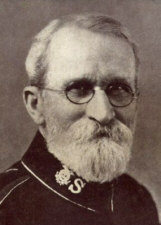 --Samuel Logan Brengle, leader of the early Salvation Army, in "The Soul-Winner's Secret"
Sunday, January 22, 2006
To be "like" Jesus...
Ever the effusive blogger, Anti-Blog provoked no small amount of thought with his most recent post (his 6th in only two years!). This is the kind of reflection that gets me out of bed in the morning - this is good stuff. So I have wrestled with Anti's thoughts for two weeks now, and I'm ready to respond with an opening salvo - hopefully something worth thinking about. I want to focus on one tenet of Anti-Blog's message: the assertion that, as human beings (qua human), we are created to reign and to rule, and called to follow the example of Christ in the exercise of this authority today.
This idea is not intrinsically unique - indeed, it is found in the very first chapter of the Bible, Genesis 1:26-28 - but it is often overlooked in more general conversations about what it means to bear the imago dei. Anti extends his idea to Jesus, invigorating Jesus as a "Second Adam" to include the idea that Jesus' authority over sickness, disease, and even the natural elements is not divinely derived (at least not immediately), but is rather a measure of his properly-ordered humanity. Anti asserts, "The authority Jesus wields is not Divine authority, in the sense of immediate Divine authority, rather, Jesus comes wielding mediated Divine authority, Adam’s authority, the authority that is the imprint, the Image of God."
Anti appeals to the famous Christ Hymn of Philippians 2 to exhort us to the same pattern - accepting our inate authority to rule and reign through an emulation of Christ and submission to the Will of God. With few qualifications, this is very standard Vineyard theological doctrine, and I myself articulate similar points in a recent paper on "loving as Christ loved." However, I was pressed by my professor to articulate more clearly what it means to "love as Christ loved," and it is this articulation that has caused me some concern. My professor's reservation is that failing to make proper distinctions between ourselves and Jesus risks blurring the distinctions between our roles and actions in the world and those of Jesus Christ. We are not Christ - we are not called to save the world from sin through the sacrifice of our blood, we are not innocent, we are not without sin, and we do not posess the Divine Word - the second person of the Trinity - in hypostatic union with our mortal flesh.
For my professor, this is not intrinsically a theological concern. As an ethicist, he is worried that we may seek to "love as Christ loved" by subverting ourselves in a manner that we are ultimately incapable of. We would be inappropriately submissive to others (a concern of feminist theologians that I share), or end up on a "cross" inappropriately and ultimately inefficaciously. Alternately, we may set ourselves up as "Christ figures," attempting to love as Christ loved, and in return, desiring the affection that only Jesus deserves.
If we are to emulate Jesus in all things, then why don't we all end up dead on a cross? I mean that quite literally. Would that be right? Why didn't all of the apostles follow Jesus in this? Why is it inappropriate for us to follow Jesus in the very act which gives us the freedom to follow him in the first place - His saving death on a cross? As I have meditated on these ideas over the past few weeks, I keep coming back to a central question: what does it mean to be like Jesus?
You see, while Anti-Blog (and many others) may be right, there are several things we must continually remind ourselves of when seeking to understand and emulate our Saviour. We are not Jesus. We will never be Jesus. We are not divine, we are not sinless. In Eden we may have been created to rule and reign, but we forfeitted our right to that crown in our disobedience in the Fall. It would be inappropriate (and likely sinful) for us to attempt to exercise authority we have ceded. Of course, part of this authority may be restored to us through redemption in Christ. But this is not following in Christ's footsteps - it is a response to Him. Jesus exercised this authority throughout His life. We may only (poorly) reflect it after the cross. As simul justus et peccator, we ought not attempt to exercise this authority until we are tranformed in the eschaton. Revelation 22:5 emphasizes this point when it speaks of us reigning with God in the end. That authority is not for today. Our theosis is only cosummated in the resurrection. While Christ reigns today and forever, only in the end will we join him and exercise the authority we were meant to have in Eden.
All of this is not to say that Anti-Blog is inherently wrong, or that the Bible does not speak in ways that suggests his assertions. But I keep running in to the concerns of my professor, and others from from my theologically conservative colleagues, who are quite concerned about the idea of attempting to literally "be like Jesus" in all things. My professor suggests an ethic that emphasizes learning to love because Jesus loved rather than constantly trying to love as Jesus loved. Since we are not God, we cannot (ontologically) loves as He does. I simply don't know how to respond to these concerns. Seriously reflection is needed to articulate an overarching hermeneutic of what it means to follow Christ. I think it is important. I think it is right. I think the Vineyard is onto something great when it emphasizes these things. But I think the concerns are right too, and I think they merit our attention and concern.
This is open call for ideas. I'm thinking about it too, but no solutions just yet. Contributions to the cause?
Grace & Peace
(You can hear Anti-Blog's sermon delivery of this piece here.)
This idea is not intrinsically unique - indeed, it is found in the very first chapter of the Bible, Genesis 1:26-28 - but it is often overlooked in more general conversations about what it means to bear the imago dei. Anti extends his idea to Jesus, invigorating Jesus as a "Second Adam" to include the idea that Jesus' authority over sickness, disease, and even the natural elements is not divinely derived (at least not immediately), but is rather a measure of his properly-ordered humanity. Anti asserts, "The authority Jesus wields is not Divine authority, in the sense of immediate Divine authority, rather, Jesus comes wielding mediated Divine authority, Adam’s authority, the authority that is the imprint, the Image of God."
Anti appeals to the famous Christ Hymn of Philippians 2 to exhort us to the same pattern - accepting our inate authority to rule and reign through an emulation of Christ and submission to the Will of God. With few qualifications, this is very standard Vineyard theological doctrine, and I myself articulate similar points in a recent paper on "loving as Christ loved." However, I was pressed by my professor to articulate more clearly what it means to "love as Christ loved," and it is this articulation that has caused me some concern. My professor's reservation is that failing to make proper distinctions between ourselves and Jesus risks blurring the distinctions between our roles and actions in the world and those of Jesus Christ. We are not Christ - we are not called to save the world from sin through the sacrifice of our blood, we are not innocent, we are not without sin, and we do not posess the Divine Word - the second person of the Trinity - in hypostatic union with our mortal flesh.
For my professor, this is not intrinsically a theological concern. As an ethicist, he is worried that we may seek to "love as Christ loved" by subverting ourselves in a manner that we are ultimately incapable of. We would be inappropriately submissive to others (a concern of feminist theologians that I share), or end up on a "cross" inappropriately and ultimately inefficaciously. Alternately, we may set ourselves up as "Christ figures," attempting to love as Christ loved, and in return, desiring the affection that only Jesus deserves.
If we are to emulate Jesus in all things, then why don't we all end up dead on a cross? I mean that quite literally. Would that be right? Why didn't all of the apostles follow Jesus in this? Why is it inappropriate for us to follow Jesus in the very act which gives us the freedom to follow him in the first place - His saving death on a cross? As I have meditated on these ideas over the past few weeks, I keep coming back to a central question: what does it mean to be like Jesus?
You see, while Anti-Blog (and many others) may be right, there are several things we must continually remind ourselves of when seeking to understand and emulate our Saviour. We are not Jesus. We will never be Jesus. We are not divine, we are not sinless. In Eden we may have been created to rule and reign, but we forfeitted our right to that crown in our disobedience in the Fall. It would be inappropriate (and likely sinful) for us to attempt to exercise authority we have ceded. Of course, part of this authority may be restored to us through redemption in Christ. But this is not following in Christ's footsteps - it is a response to Him. Jesus exercised this authority throughout His life. We may only (poorly) reflect it after the cross. As simul justus et peccator, we ought not attempt to exercise this authority until we are tranformed in the eschaton. Revelation 22:5 emphasizes this point when it speaks of us reigning with God in the end. That authority is not for today. Our theosis is only cosummated in the resurrection. While Christ reigns today and forever, only in the end will we join him and exercise the authority we were meant to have in Eden.
All of this is not to say that Anti-Blog is inherently wrong, or that the Bible does not speak in ways that suggests his assertions. But I keep running in to the concerns of my professor, and others from from my theologically conservative colleagues, who are quite concerned about the idea of attempting to literally "be like Jesus" in all things. My professor suggests an ethic that emphasizes learning to love because Jesus loved rather than constantly trying to love as Jesus loved. Since we are not God, we cannot (ontologically) loves as He does. I simply don't know how to respond to these concerns. Seriously reflection is needed to articulate an overarching hermeneutic of what it means to follow Christ. I think it is important. I think it is right. I think the Vineyard is onto something great when it emphasizes these things. But I think the concerns are right too, and I think they merit our attention and concern.
This is open call for ideas. I'm thinking about it too, but no solutions just yet. Contributions to the cause?
Grace & Peace
(You can hear Anti-Blog's sermon delivery of this piece here.)
Sunday, January 08, 2006

Put this in your weblog if you know someone who is fighting, has survived, or died from pirate attacks.
-----------------------------------------------------------------------
Today we salute you, Mr. Constant Collar Putter Upper. You, bedecked in popped collar, teach us that we no longer have to live with a cold, back of the neck. Sure, your pink alligator polo may look feminine to some, but not the 17 other frat guys wearing the same thing at the bar. Where others may see thoughtless fashion conformity, you preach a higher gospel. You preach of a world where it is okay for a man to go tanning. You ask "why can't we wear makeup, and use shampoo with lavender essence?" So crack open a fresh bottle of candy cologne, Mr. Abercrombie (or is it Fitch?), because we all know, when we really need a piece of gum, you might have one...in your man purse.

Tuesday, January 03, 2006
Beautiful or Cute?
The following paragraph was taken from the NYTimes article (here) about what humans find "cute." The article focused specifically on why we find certain animals (particularly infant mammals) cute, but I was struck by its potential application to our notions of intrahuman attraction as well. Read...and if you feel so moved, discuss.
"Cuteness is distinct from beauty, researchers say, emphasizing rounded over sculptured, soft over refined, clumsy over quick. Beauty attracts admiration and demands a pedestal; cuteness attracts affection and demands a lap. Beauty is rare and brutal, despoiled by a single pimple. Cuteness is commonplace and generous, content on occasion to cosegregate with homeliness."
Grace & Peace
"Cuteness is distinct from beauty, researchers say, emphasizing rounded over sculptured, soft over refined, clumsy over quick. Beauty attracts admiration and demands a pedestal; cuteness attracts affection and demands a lap. Beauty is rare and brutal, despoiled by a single pimple. Cuteness is commonplace and generous, content on occasion to cosegregate with homeliness."
Grace & Peace
Monday, January 02, 2006
Mother, can we trust the NFPers?
I've recently begun to wonder whether the NFPers (Natural Family Planning types) tend to promote urban legends about oral contraception in order to discourage its use among Christians. I have mostly anecdotal evidence for this, nothing hard and fast, but it causes me a certain amount of frustration. I know that NFP people are essentially working from a philosophical position that differs from my own, but I don't want to see elements that disagree with their philosophy unfairly slandered.
WebMD lists the advantages and disadvantages of oral forms of contraception. These are specifically for those forms that contain both estrogen and progestin.
The advantages that apply to most Christians include:
Grace & Peace
WebMD lists the advantages and disadvantages of oral forms of contraception. These are specifically for those forms that contain both estrogen and progestin.
The advantages that apply to most Christians include:
- Reduced bleeding and cramping with periods, which lowers the risk of anemia
- Reduced pain during ovulation
- Reduced fibrocystic breast changes
- Reduced risk of pelvic inflammatory disease (PID)
- Reduced risk of ectopic pregnancy
- May reduce acne
- May reduce ovarian cysts
- May reduce symptoms of endometriosis
- May reduce bone density loss
- May protect against ovarian and endometrial cancer
- Pills must be taken every day
- May not be as effective when taken with certain medications
- May delay return of normal cycles when heavy dosage is used.
- May cause weight gain when heavy dosage is used. (thanks to Ellen for this reminder)
- May cost more than other methods if used for many years
- Does not protect against sexually transmitted diseases such as HIV.
Grace & Peace
Wednesday, December 14, 2005
Whizzing in the Spirit
The following is a hysterical quote from from the radio show "Stand to Reason," with Gregory Koukl. It reflects the strange and occasionally circular way people discuss "new movements of the Spirit":
Grace & Peace
What if I told you that you should come with me to a church that has a brand new work of the Spirit? You say, what is it? I say, when the Spirit moves us, we stand in a circle and urinate into a big tub. We pee in a pot. We call it "whizzing in the Spirit." You say, Koukl, that's bizarre. I say, there are no verses against it. Find a verse against it. In fact, I've got a proof text: "From his innermost being shall flow rivers of living water." There it is! Works for me! After all, you can't put God in a box, can you? God can do whatever He wants, can't He? So who are you to judge Him?You gotta admit...that's pretty damn funny.
Grace & Peace
Tuesday, December 13, 2005
Defending Luke (or, "Quirinius, we still love you!")
I am undoubtedly among the worst of our merry band to enter a discussion on historical issues. So, I will merely offer a few timely observations as we approach the Christmas season. (Anti-Blog, this is mostly for you.)
The Problem:
Luke 2:1-2 states that Quirinius was the Roman governor of Syria when Jesus was born. This statement occasionally puzzles historians because Quirinius was appointed governor of Syria in 6AD, and Luke dates the birth of Jesus to the reign of Herod the Great (1:5), who, according to Josephus (Ant. 17.7.1 191), Strabo, and Tacitus, died in 4 BC. This appears to render Luke's account historically irreconciliable.
Possible Solutions:
That Augustus issued a census decree is both reasonable and plausible. Augustus' propensity to count and tax is well known. According to the Acts of Augustus (see #8 therein), Augustus ordered three censuses (censi?) during his reign (27BC-14AD). Interestingly, an Antioch manuscript exists with an inscription describing a soldier who was 'legate of Syria' twice during this time frame. There are two common interpretations: one is that it refers to Q. Varus, and the other that it refers to Quirinius himself. The New Bible Dictionary (IVP:1996) says this (s.v. "Quirinius"):
E.M. Blaiklock, writing for Zondervan's Biblical Encyclopedia believes that Quirinius was in Syria for an earlier tour of duty, not as governor but in some other leadership capacity (s.v. "Quirinius"). It is notable that term Luke uses for Quirinius' is the general term hegemon, which in Greek can apply to prefects, provincial governors, and even Caesar himself. Even in the Testament it applies to procurators--pilate, festus, felix--and to general 'rulers' (Mt 2.6). The New Intl. Dict. of New Test. Theology gives 'leader, commander, chief' (vol 1.270) as among the possible range of meanings. Of course, this term would have applied to Quirinius at several points in his career. In the proper sense, there might also be several individuals so addressed at the same time. Justin Martyr specifically refers to Quirinius as 'procurator' in Apology 1:34.
However, even if Quirinius is not the referred legate, Grammatical Insights into the New Testament (pgs 23-24) implies that Luke 2:2 "prote" can (should?) be translated 'before the census of Quirinius' instead of the usual 'first census of Quirinius.' This potentially solves the problem without requiring two terms of office for Quirinius at all.
Either way, if we admit the weakness of the historical record (Joesphus himself is often confused about dates and numbers), it appears that Luke's case, as articulated in chapter 2, has serious potential to be correct as it was originally written.
This post is the result of a few days of simple research and not a lifetime of careful analysis. Obviously, there is much more than can be said. I'm not even going to attempt to go beyond the simple issue of Quirinius here. That would just take too long. But, I hope this proves that these are still live issues worthy of examination and discussion, and that a more 'traditional' read is not outside the realm of intellectual honesty.
Grace & Peace
The Problem:
Luke 2:1-2 states that Quirinius was the Roman governor of Syria when Jesus was born. This statement occasionally puzzles historians because Quirinius was appointed governor of Syria in 6AD, and Luke dates the birth of Jesus to the reign of Herod the Great (1:5), who, according to Josephus (Ant. 17.7.1 191), Strabo, and Tacitus, died in 4 BC. This appears to render Luke's account historically irreconciliable.
Possible Solutions:
That Augustus issued a census decree is both reasonable and plausible. Augustus' propensity to count and tax is well known. According to the Acts of Augustus (see #8 therein), Augustus ordered three censuses (censi?) during his reign (27BC-14AD). Interestingly, an Antioch manuscript exists with an inscription describing a soldier who was 'legate of Syria' twice during this time frame. There are two common interpretations: one is that it refers to Q. Varus, and the other that it refers to Quirinius himself. The New Bible Dictionary (IVP:1996) says this (s.v. "Quirinius"):
The possibility that Quirinius may have been governor of Syria on an earlier occasion... has found confirmation in the eyes of a number of scholars (especially W. M. Ramsay) from the testimony of the Lapis Tiburtinus (CIL, 14. 3613). This inscription, recording the career of a distinguished Roman officer, is unfortunately mutilated, so that the officer’s name is missing, but from the details that survive he could very well be Quirinius. It contains a statement that when he became imperial legate of Syria he entered upon that office ‘for the second time’ (Lat. iterum). The question is: did he become imperial legate of Syria for the second time, or did he simply receive an imperial legateship for the second time, having governed another province in that capacity on the earlier occasion?...The wording is ambiguous. Ramsay held that he was appointed an additional legate of Syria between 10 and 7 bc, for the purpose of conducting the Homanadensian war, while the civil administration of the province was in the hands of other governors, including Sentius Saturninus (8-6 bc), under whom, according to Tertullian (Adv. Marc. 4. 19), the census of Lk. 2:1ff. was held.Perhaps Luke 2:2, "This was the first census that took place while Quirinius was governor of Syria" is saying that there was second census that Quirinius oversaw. Josephus documents a census taken early in Quirinius' term of office (Antiquities 18.1.1 1). In fact, Luke also mentions a second census himself in Acts 5:37.
E.M. Blaiklock, writing for Zondervan's Biblical Encyclopedia believes that Quirinius was in Syria for an earlier tour of duty, not as governor but in some other leadership capacity (s.v. "Quirinius"). It is notable that term Luke uses for Quirinius' is the general term hegemon, which in Greek can apply to prefects, provincial governors, and even Caesar himself. Even in the Testament it applies to procurators--pilate, festus, felix--and to general 'rulers' (Mt 2.6). The New Intl. Dict. of New Test. Theology gives 'leader, commander, chief' (vol 1.270) as among the possible range of meanings. Of course, this term would have applied to Quirinius at several points in his career. In the proper sense, there might also be several individuals so addressed at the same time. Justin Martyr specifically refers to Quirinius as 'procurator' in Apology 1:34.
However, even if Quirinius is not the referred legate, Grammatical Insights into the New Testament (pgs 23-24) implies that Luke 2:2 "prote" can (should?) be translated 'before the census of Quirinius' instead of the usual 'first census of Quirinius.' This potentially solves the problem without requiring two terms of office for Quirinius at all.
Either way, if we admit the weakness of the historical record (Joesphus himself is often confused about dates and numbers), it appears that Luke's case, as articulated in chapter 2, has serious potential to be correct as it was originally written.
This post is the result of a few days of simple research and not a lifetime of careful analysis. Obviously, there is much more than can be said. I'm not even going to attempt to go beyond the simple issue of Quirinius here. That would just take too long. But, I hope this proves that these are still live issues worthy of examination and discussion, and that a more 'traditional' read is not outside the realm of intellectual honesty.
Grace & Peace
Monday, December 05, 2005
Props to the SJV
I'm passing out props to my people in the San Joaquin Valley - according to a yearly study by Men's Fitness Magazine, two (2!) SJV cities rank among America's fittest! My old stomping grounds, "the Fres-yes," tops out as the 14th fittest city in the U.S.ofA. How about that for unexpected?! A lot of people make fun of Fresno, and my family moved to the outlying community of Clovis (30m Northeast) when I was 8, but at least it is among the healthiest places to live. I also give out major props to the people of Sacramento, the 7th fittest city in America.
The complete results of the 2005 study are here.
Now, I'm not trying to say anything in particular to my non-Cali friends, but did any of you notice how many of the fittest cities in America are in California?! (hint: the answer is 7). Yup, that's what I thought...ya'll best step back an' recognize! (*grin*)
Grace & Peace Out!
The complete results of the 2005 study are here.
Now, I'm not trying to say anything in particular to my non-Cali friends, but did any of you notice how many of the fittest cities in America are in California?! (hint: the answer is 7). Yup, that's what I thought...ya'll best step back an' recognize! (*grin*)
Grace & Peace Out!
Friday, December 02, 2005
Waiting for the Revolution
What is it that you're waiting for?
I am waiting for the Revolution to begin. I am waiting for nuclear fission to start: when all the elements are in place, the chemicals are in sufficient quantity, when the energy thresholds have been overcome and the critical mass is present. I am waiting for that uncontrolled chain-reaction that will spread out from the detonation point, igniting somthing far beyond my wildest expectations! I am waiting for the Revolution.
Did you know that Lenin was first arrested in 1895? He spent more than a year in prison, and didn't see the Soviet Revolution until 1917. More than 20 years later. I have been talking about the Revolution since 2000. I remember standing in Dwight, talking with Anti-Blog about the impending Revolution. But it never really materialized. Then 2001-2002 was supposed to be the year. Porterhouse was our critical mass - but it never spread beyond the walls. By 2003, we were moving out. People were leaving, and the spirit of revolution with it.
Somehow we were harvested back, well most of us anyway. The agony of those lost grieves me. But our Colony appears yet more promising - stronger, more mature, wiser - and I believe that the Revolution may yet break out. I am waiting, time is passing, sparks are flying and the heat is simmering. Still I am waiting...for the sparks to catch; for flame to take hold; for the reaction to begin that will sweep outward and I'll gaze in awe, throwing my strength into the fire and my back to the work, barely able to hang on because it won't come from me when it comes. From He who calls these elements together, I don't want to lose any more.
I am ready for the Revolution.
Grace & Peace
I am waiting for the Revolution to begin. I am waiting for nuclear fission to start: when all the elements are in place, the chemicals are in sufficient quantity, when the energy thresholds have been overcome and the critical mass is present. I am waiting for that uncontrolled chain-reaction that will spread out from the detonation point, igniting somthing far beyond my wildest expectations! I am waiting for the Revolution.
Did you know that Lenin was first arrested in 1895? He spent more than a year in prison, and didn't see the Soviet Revolution until 1917. More than 20 years later. I have been talking about the Revolution since 2000. I remember standing in Dwight, talking with Anti-Blog about the impending Revolution. But it never really materialized. Then 2001-2002 was supposed to be the year. Porterhouse was our critical mass - but it never spread beyond the walls. By 2003, we were moving out. People were leaving, and the spirit of revolution with it.
Somehow we were harvested back, well most of us anyway. The agony of those lost grieves me. But our Colony appears yet more promising - stronger, more mature, wiser - and I believe that the Revolution may yet break out. I am waiting, time is passing, sparks are flying and the heat is simmering. Still I am waiting...for the sparks to catch; for flame to take hold; for the reaction to begin that will sweep outward and I'll gaze in awe, throwing my strength into the fire and my back to the work, barely able to hang on because it won't come from me when it comes. From He who calls these elements together, I don't want to lose any more.
I am ready for the Revolution.
Grace & Peace
Thursday, December 01, 2005
Shameless personal plug
I feel slightly famous and desire to share this with anyone interested. I preached my first official "sermon" this past Sunday at the New Haven Vineyard. As part of my internship there this year, I will preach two sermons to the congregation. I'll probably preach again in the Spring. It was pretty nerve-wracking, even for someone used to being up on stage! In all honesty, I don't remember a lot about the actual event - I think I was worried about getting through without making mistakes, making sure my points were intelligible, and hoping that it all made sense - but I got a lot of positive feedback, for which I am incredibly appreciative.
So...if you want to hear my first attempt in crystal clear, .mp3 audio, the link is here! You can listen to this sermon, and several others, at:
http://www.vineyardnewhaven.org/message/sermon.htm
If you want, just save the file to your computer and listen to it whenever you have time. I hope you enjoy!
Grace & Peace
So...if you want to hear my first attempt in crystal clear, .mp3 audio, the link is here! You can listen to this sermon, and several others, at:
http://www.vineyardnewhaven.org/message/sermon.htm
If you want, just save the file to your computer and listen to it whenever you have time. I hope you enjoy!
Grace & Peace
 | Currently Spinning "Copland: The Music of America" |
Tuesday, November 15, 2005

Thursday, November 03, 2005
Weekly Battles
It’s not a bad place really. The AIDS center feels like something between a hospital ward and a nursing home. It always smells vaguely of cleaning chemicals, medicine, and bodies that don’t stay as clean as the rest of us. But it’s not a bad place. There is plenty of light, fun things to do, and the staff are friendly and competent.
I don’t know how long he’s been here. But visiting him is the cornerstone of my trip each week. Usually there are three of us that go and visit the folks living there. He’s probably in his early 60’s. An African-American man, who says that he used to be 6’3”, 235lbs, but a recent stroke has deprived him of the use of his arm and consistent use of his right leg, so he’s wheelchair bound. Most of the time he just lies in bed. What little body he has left is protruding with tubes beneath the sheets of his bed.
I get the impression that other folks don’t like him much. I don’t think he’s really a “good neighbor.” Although there are brightly colored paintings on the outside of the door – paintings he has created but look like a child’s – he is not very friendly with the other patients, the staff, or many other visitors. For some reason he just seems to like us. No one really knows why.
We always come about the same time in the afternoon. And like clockwork we talk to him about his week, about baseball (he’s a diehard Red Sox fan) and about how he is feeling – all while Jerry Springer plays on the t.v. above his bed. I don’t know if you’ve ever tried to concentrate on a conversation while Jerry Springer-style fights rage above your head, but it is not easy. The interesting thing about him, and about most of the patients there, is that they never talk about their HIV or AIDS. When you ask them how they are doing, they’ll say “doing alright. But my arm is hurting this week.” Or, “better this week, but I can’t get rid of this cough.” If they ever do mention it, it is ‘the virus,’ or ‘my condition,’ - but they almost never do.
This week, after 15 minutes of visiting with him, we asked if we could pray, and what we should pray for. Like always he asked for prayer for increased mobility in his arm and leg. I don’t even know if he believes in God. “Dear Heavenly Father…” and the three of us began to pray. He never prays aloud with us – just closes his eyes there on the hospital bed and listens, while Jerry Springer plays in the background. We implore God to come and heal his leg and arm, “God, you are a God who heals. Come and touch this man – make his body strong again.” I know that the three of us are all praying for ‘the virus’ in our heads, but none of us mentions it aloud. I believe that God does heal, that God can supernaturally transform this man just like Jesus did at the
As I stand there beside the bed, I rationalize that there are lots of reasons why God doesn’t choose to heal through my prayers. I’m not a very good Christian sometimes. I snapped at someone the other day. I haven’t been regular in my personal devotions. But I can dismiss those in my head as quickly as they appear. Of course, that doesn’t mean I don’t believe them somewhere. As we finish our prayer, he smiles and shakes hands with the three of us. We smile and talk about the upcoming basketball season, something sure to lift his spirits after a disappointing Red Sox season. And all the while I am left in my own head, wondering why I even bother to pray. Is it for this man’s sake – this person who I don’t even know believes in God? Am I trying to accomplish something else? What good is prayer if I’m not sure that I really expect God to do anything? Maybe I should be praying for something else entirely…and we turn in our visitor badges. And the three of us walk out the door – talking about the World Series.
Grace & Peace
Wednesday, October 26, 2005
A Pity, We Were Such A Good Invention
A poem, by Yehuda Amichai
They amputated
your thighs off my hips.
As far as I'm concerned
They are all surgeons. All of them.
They dismantled us
Each from the other.
As far as I am concerned
They are all engineers. All of them.
A pity. We were such a good
And loving invention.
An aeroplane made from a man and wife.
Wings and everything.
We hovered a little above the earth.
We even flew a little.
Grace & Peace
They amputated
your thighs off my hips.
As far as I'm concerned
They are all surgeons. All of them.
They dismantled us
Each from the other.
As far as I am concerned
They are all engineers. All of them.
A pity. We were such a good
And loving invention.
An aeroplane made from a man and wife.
Wings and everything.
We hovered a little above the earth.
We even flew a little.
Grace & Peace
Subscribe to:
Posts (Atom)