Wow, after a month of not posting (for no particular reason), I have concluded that I am simply a little "burned out." My recent finals season was the most intense of my academic career, both in terms of volume and content, and I simply pushed myself beyond a limit, such that it is difficult to motivate myself to sit down and write anything coherent. But rest assured, strange in incoherent thoughts still percolate in my brain, and I have faith that they will cohere sometime soon and the madness will again ensue.
But for the moment, how old do you feel? Attached here is a sound file; if you can hear the noise, you have the ears of someone less than 24 years old. The tone is a new cellphone ringtone used by students in the UK and the US. Since most adults over the age of 24 cannot hear the tone, students are able to keep their cellphones on in class without their teachers knowing. For more information, the entire article is available here.
Grace & Peace
Wednesday, June 14, 2006
Thursday, May 11, 2006

Wednesday, May 10, 2006
A Lesson in Hermeneutics
"In Kenya, vervet monkeys take the ground
Until a sentry gives a chattering bark,
Which in the simple vervet lexicon
Means snake, and connotes evil, death, and dark.
Or else the sentry makes a gutteral sound
That translates in our own more complex tongue
To hawk or eagle circling for prey,
And sends the mokeys scampering. Either way,
The monkeys must take action - jump or flee
Across the ground or to a sheltering tree.
Should one, instead, hearing a sentry speak,
Decide to deconstruct the fellow's meaning
And prove all urgent chattering oblique,
A python's fang or hawk's cruel curving beak
Will punctuate the monkey's idle preening,
Ending his dissertation in mid-squeak." --Paul Lake
Grace & Peace
Until a sentry gives a chattering bark,
Which in the simple vervet lexicon
Means snake, and connotes evil, death, and dark.
Or else the sentry makes a gutteral sound
That translates in our own more complex tongue
To hawk or eagle circling for prey,
And sends the mokeys scampering. Either way,
The monkeys must take action - jump or flee
Across the ground or to a sheltering tree.
Should one, instead, hearing a sentry speak,
Decide to deconstruct the fellow's meaning
And prove all urgent chattering oblique,
A python's fang or hawk's cruel curving beak
Will punctuate the monkey's idle preening,
Ending his dissertation in mid-squeak." --Paul Lake
Grace & Peace


Monday, May 08, 2006
we know that suffering produces perseverance
“I have no sympathy with the idleness that would contrast this fighting with the teachings of the pulpit; for, perchance, more virtue is being practiced at Sevastopol than in many years of peace. It is a pity that we seem to require a war, from time to time, to assure us that there is any manhood still left in man.”
-Henry David Thoreau. Letter, February 7, 1855, to Thomas Cholmondeley, in The Writings of Henry David Thoreau, vol. 6, pp. 249-250, Houghton Mifflin (1906).
-Henry David Thoreau. Letter, February 7, 1855, to Thomas Cholmondeley, in The Writings of Henry David Thoreau, vol. 6, pp. 249-250, Houghton Mifflin (1906).
Saturday, April 29, 2006
'To be' is to be called...
There is a contradiction between the theology and practice of ordained ministry in the Vineyard Church that I have had trouble identifying...until now. In my discussions with close friends (Anti-Blog and The Great PB among them), I have been made aware of this tension, but I have had trouble articulating exactly what it is. According to various statements (official and otherwise), "to be" an ordained minister in the Vineyard is "to do" the stuff that an ordained minister needs to do. Of, course, it's not exactly that simple. To be ordained might better be stated (from this perspective) as "the recognition and affirmation of a person doing the things of ordained ministry."
This "to be is to do" model is argued most forcefully by Anti-Blog in our various conversations, and has many theological and practical advantages. One of the interesting characteristics of this model is that "ordination" only applies to people who are currently serving in a pastoral capacity; that is, you don't remain ordained once you retire from the ministry, or move on to another job. Another interesting element is that your ordination is tied to the local Vineyard Church that ordained you, and not to a larger directory of (or authority over) Vineyard pastors. Much of this perspective undoubtedly comes from the Vineyard self-understanding as a "church planting movement." Because the Vineyard is relatively young (around 30-years-old), most of its pastors have been church planters. These individuals (or couples, mostly couples), have been sent by local congregations, venturing into territory with no other Vineyard Churches and established these churches themselves. In this way, the church planters served in a missionary capacity at the behest of their former local congregation, evangelizing the unchurched in primarily urban/suburban settings and establishing a Vineyard presence in those areas.
If Vineyard pastors are essentially missional church planters, then several practical and theological implications ensue. First, whatever is not required of a missionary should not be required of a pastor. This means that advanced seminary degrees are not required for ministry, nor are lifelong commitments to "vocational ministry." Just as missionaries may not be seminary trained, and may feel called to serve for a period of a few years, so pastors (church planters) may only be involved for a period of time. Second, it means that pastors can be affirmed as a married couple, and not merely as an individual (male or female). Both the man and the woman are serving in a pastoral capacity. Just as you cannot drag your husband or wife to Borneo (for example) and pretend that only one of you is a missionary, the same is true for the church planting couple. Finally, it emphasizes the Protestant notion of the "priesthood of all believers" and affirms it in such a way as to recognize the practial importance of an administrator, while at the same time freeing others in the congregation to perform important elements of traditional pastoral ministry (preaching, administering sacraments, counseling, etc.).
Interestingly enough, this explicit and implied theological position tends to run into problems not in theory, but "in practice," because in practice, most Vineyards are not set up this way. In fact, it can look like Vineyards are hypocritical when it comes to the "working-out" of this theological position in the real world. As articulated, this model seems to point toward a strong belief in "team leadership," based on the notion of the priesthood of all believers, whereby one person (or a married couple) assumes a sort-of "leadership by default" - by virtue of their recognition of the practical needs of the church and their desire to meet them. In this context, however, most of the real leadership takes place among a group of leaders, identified by their desire to engage with the mission of the church and their love and compassion for its local members. This vision is not the reality in many Vineyard Churches. At my current church home, there is one clear leader. Despite strong personal relationships and the value placed on discipling people in leadership, everyone else stands in a reduced position of authority to the pastor, no matter what their leadership capacity. For The Great PB, "the buck stops here." Whether or not this is a remnant of the more authoritative pastoral model of Calvary Chapel (the movement from which many Vineyard pastors came) seems irrelevant. At the Cincinnati Vineyard Christian Fellowship, I never met the wife of the senior pastor, despite the fact that I spoke with him on many occasions and worshipped with him for almost two years. It was a large church with multiple services, and meeting everyone (and establishing a strong relationship with them) was simply impossible. It was clear in this context that he was the one serving in the leadership position, and not his wife. Of course, this worked out fine in a place like Cincinnati, with an established church in a situation where the spouse had no desire to be a "pastor," or even less perhaps a traditional "pastor's wife."
The appearance of hypocrisy in the "to be is to do" model slides all the way back to John Wimber himself. Although Wimber was very open to God doing just about anything in the context of the Church, he only allowed men to serve as senior pastors, out of respect for what he saw as a clear mandate in the Biblical tradition. Yet in a missional, "to be is to do" model, this makes no sense! Not only are women occasionally "doing" the work of ordained ministry, but they are often serving right alongside their husbands and missionary church-planters, and deserve the recognition as such. If "to be is to do," women who "do" pastoral things ARE pastors, and should be accorded the same recognition.
Unfortunately, I believe that "to be is to do" is an insufficient model for understanding pastoral ministry, and rests on foundations that do not take into account the full thrust of the Biblical and historical tradition. We need to look for a different model that takes these various elements into account. I believe that a better foundation for a Vineyard theology of ordination is an understanding that "to be" is not "to do." Instead, "to be is to be called by God," and to answer that call appropriately. Think about it: the role of pastor, of shepherding the people of God and leading a Church that is "for the world" is not something you do now and then, because no one else is doing it, like being a little league coach or stepping up and cooking meals for the soup kitchen. Pastors serve a more important role than simply "filling in the leadership gap" in a church. In fact, I believe pastors are responding to a direct calling of God upon their lives to dedicate part of their on Earth to the service of the Kingdom of God. This does not have to be a lifelong calling, or even necessarily a full-time calling, but it is nevertheless a serious and weighty calling.
Of course, this is actually the same for missionaries and church planters! It is not meant to be a distinction. It's not as though the pastoral calling is somehow ontologically distinct. But we need to recognize that missionaries, pastors, and many other roles serve not at the behest of a whim or even a need, but at the calling of God. It is the call the we respond to, and in the proper response of that call we become ministers of the Gospel of Christ. The actual ordination process (like that of baptism or communion) is merely the Church's recognition and affirmation of that calling.
Understanding "to be is to be called" has several advantages. For one, I believe it aligns more closely with the Biblical narrative. Yes, the Bible affirms the priesthood of all believers; yes, Paul talks about Spiritual giftings available to everyone. But this does not mean that everyone has each of these gifts! Not everyone is called to be an apostle, nor just anyone a prophet. From the very beginning - when God called Abraham, through the anointing of King Saul and King David, to the callings of the Old Testament prophets, and ultimately the Disciples and Paul on the Damascus Road, God chose certain people and invited them to play a unique role in His plan for the World. Some are called to be prophets, some to be teachers and preachers...Paul recognized these as distinct gifts that are imparted by the Holy Spirit, and only affirmed by the Church.
This understanding solves a few other dilemmas as well. For example, since it is God that calls, it is He who determines who will be chosen. God can call whomever He wants, and can choose not to call whomever He wants. It is at least consistent in this framework to say that, while God may call both men and women to missionary roles or to other church function, God may choose to restrict the calling of senior pastors to males. I am not necessarily claiming that this is in fact the case, but I respect John Wimber's understanding of the New Testament, and it is my desire to remove the appearance of hypocrisy within the framework of ordained leadership. (I might offer a tentative explanation of this by noting that perhaps God desires to model the pastor-church relationship on His own relationship to the universal Church - so limiting those whom He calls by virtue of upholding some element of that relationship.) This is not to denigrate the importance of feminine leadership in the Church, nor is it to undermine the priesthood of all believers. Affirming the central importance of calling does not absolve the priesthood of all believers any more than Jesus calling the Twelve does. Similarly, it does not increase the "bureaucracy" of the Church to a mainline levels, because it is God's calling, not an M.Div. or some fancy process that establishes the pastor in his capacity. The Church merely recognizes that calling, and affirms it.
I will admit that part of my emphasis comes from my observation of the way Vineyards actually function, and the appropriate (I believe) emphasis they implicitly place on the unique calling to ministry displayed by those seeking ordination. This is occasionally in spite of their "to be is to do" rhetoric! They seem to understand the importance ordination without properly being able to articulate just why is it so. My mindset shaped by my understanding of my own call to pastoral ministry in the military chaplain corps. This role is very distinct, both in the Church and in the military, and allows for a unique kind of access to authority by virtue of this position. It is not something you just "start doing" and are then recognized. For military chaplains, "to be" is most certainly not "to do." It is a position that entails rights and responsibilities that are occasionally matters of life and death. Just as an apostle has certain responsibilities, a prophet has others, and an evangelist still others, so too does the chaplain/pastor. You do not leave the Church to become a prophet, evangelist or pastor. You are not called out from the Church for these roles. Instead, the ministry is internal to the church body and to the world. But the recognition and affirmation of that calling provides both responsibilities and rights. It may be important to be called "Pastor _____", or perhaps in certain occasions to wear a certain type of clothing. This is not to highlight your special characteristics as special, but to enable those in your care (or perhaps more importantly, in the world) to recognize your calling and identify you as someone who might help them see God in their situation. In the military, I will be addressed as "Chaplain ________." I will wear a uniform with a cross on the sleeve and on the collar, so that anyone who sees me will know that they can approach me with spiritual questions and have confidence that I will take the time to help them address these questions. The same rules apply in the civilian world (although perhaps less distinction is required for practical purposes) and there is no reason to shun either the rights or the responsibilities of a calling from God under the pretense of false humility or "team leadership." Humility and team leadership are important, but we must recognize that God calls certain individuals to distinct roles in the church (prophets, evangelists, pastors, etc.), and if he has done so for a reason, then we ought to step aside and let them do their job, or step out ourselves in confidence and live out those rights and responsibilities. To do otherwise is to undermine God's call.
A proper understanding of Vineyard theology of ordination ought to focus not on "to be is to do." This notion fails not only on the practical level, but also on the theological and Scriptural ones as well. God's call will lead us to understand rather that "to be is to be called," and to respond and be affirmed appropriately in that calling...I welcome your thoughts and considerations.
Grace & Peace
This "to be is to do" model is argued most forcefully by Anti-Blog in our various conversations, and has many theological and practical advantages. One of the interesting characteristics of this model is that "ordination" only applies to people who are currently serving in a pastoral capacity; that is, you don't remain ordained once you retire from the ministry, or move on to another job. Another interesting element is that your ordination is tied to the local Vineyard Church that ordained you, and not to a larger directory of (or authority over) Vineyard pastors. Much of this perspective undoubtedly comes from the Vineyard self-understanding as a "church planting movement." Because the Vineyard is relatively young (around 30-years-old), most of its pastors have been church planters. These individuals (or couples, mostly couples), have been sent by local congregations, venturing into territory with no other Vineyard Churches and established these churches themselves. In this way, the church planters served in a missionary capacity at the behest of their former local congregation, evangelizing the unchurched in primarily urban/suburban settings and establishing a Vineyard presence in those areas.
If Vineyard pastors are essentially missional church planters, then several practical and theological implications ensue. First, whatever is not required of a missionary should not be required of a pastor. This means that advanced seminary degrees are not required for ministry, nor are lifelong commitments to "vocational ministry." Just as missionaries may not be seminary trained, and may feel called to serve for a period of a few years, so pastors (church planters) may only be involved for a period of time. Second, it means that pastors can be affirmed as a married couple, and not merely as an individual (male or female). Both the man and the woman are serving in a pastoral capacity. Just as you cannot drag your husband or wife to Borneo (for example) and pretend that only one of you is a missionary, the same is true for the church planting couple. Finally, it emphasizes the Protestant notion of the "priesthood of all believers" and affirms it in such a way as to recognize the practial importance of an administrator, while at the same time freeing others in the congregation to perform important elements of traditional pastoral ministry (preaching, administering sacraments, counseling, etc.).
Interestingly enough, this explicit and implied theological position tends to run into problems not in theory, but "in practice," because in practice, most Vineyards are not set up this way. In fact, it can look like Vineyards are hypocritical when it comes to the "working-out" of this theological position in the real world. As articulated, this model seems to point toward a strong belief in "team leadership," based on the notion of the priesthood of all believers, whereby one person (or a married couple) assumes a sort-of "leadership by default" - by virtue of their recognition of the practical needs of the church and their desire to meet them. In this context, however, most of the real leadership takes place among a group of leaders, identified by their desire to engage with the mission of the church and their love and compassion for its local members. This vision is not the reality in many Vineyard Churches. At my current church home, there is one clear leader. Despite strong personal relationships and the value placed on discipling people in leadership, everyone else stands in a reduced position of authority to the pastor, no matter what their leadership capacity. For The Great PB, "the buck stops here." Whether or not this is a remnant of the more authoritative pastoral model of Calvary Chapel (the movement from which many Vineyard pastors came) seems irrelevant. At the Cincinnati Vineyard Christian Fellowship, I never met the wife of the senior pastor, despite the fact that I spoke with him on many occasions and worshipped with him for almost two years. It was a large church with multiple services, and meeting everyone (and establishing a strong relationship with them) was simply impossible. It was clear in this context that he was the one serving in the leadership position, and not his wife. Of course, this worked out fine in a place like Cincinnati, with an established church in a situation where the spouse had no desire to be a "pastor," or even less perhaps a traditional "pastor's wife."
The appearance of hypocrisy in the "to be is to do" model slides all the way back to John Wimber himself. Although Wimber was very open to God doing just about anything in the context of the Church, he only allowed men to serve as senior pastors, out of respect for what he saw as a clear mandate in the Biblical tradition. Yet in a missional, "to be is to do" model, this makes no sense! Not only are women occasionally "doing" the work of ordained ministry, but they are often serving right alongside their husbands and missionary church-planters, and deserve the recognition as such. If "to be is to do," women who "do" pastoral things ARE pastors, and should be accorded the same recognition.
Unfortunately, I believe that "to be is to do" is an insufficient model for understanding pastoral ministry, and rests on foundations that do not take into account the full thrust of the Biblical and historical tradition. We need to look for a different model that takes these various elements into account. I believe that a better foundation for a Vineyard theology of ordination is an understanding that "to be" is not "to do." Instead, "to be is to be called by God," and to answer that call appropriately. Think about it: the role of pastor, of shepherding the people of God and leading a Church that is "for the world" is not something you do now and then, because no one else is doing it, like being a little league coach or stepping up and cooking meals for the soup kitchen. Pastors serve a more important role than simply "filling in the leadership gap" in a church. In fact, I believe pastors are responding to a direct calling of God upon their lives to dedicate part of their on Earth to the service of the Kingdom of God. This does not have to be a lifelong calling, or even necessarily a full-time calling, but it is nevertheless a serious and weighty calling.
Of course, this is actually the same for missionaries and church planters! It is not meant to be a distinction. It's not as though the pastoral calling is somehow ontologically distinct. But we need to recognize that missionaries, pastors, and many other roles serve not at the behest of a whim or even a need, but at the calling of God. It is the call the we respond to, and in the proper response of that call we become ministers of the Gospel of Christ. The actual ordination process (like that of baptism or communion) is merely the Church's recognition and affirmation of that calling.
Understanding "to be is to be called" has several advantages. For one, I believe it aligns more closely with the Biblical narrative. Yes, the Bible affirms the priesthood of all believers; yes, Paul talks about Spiritual giftings available to everyone. But this does not mean that everyone has each of these gifts! Not everyone is called to be an apostle, nor just anyone a prophet. From the very beginning - when God called Abraham, through the anointing of King Saul and King David, to the callings of the Old Testament prophets, and ultimately the Disciples and Paul on the Damascus Road, God chose certain people and invited them to play a unique role in His plan for the World. Some are called to be prophets, some to be teachers and preachers...Paul recognized these as distinct gifts that are imparted by the Holy Spirit, and only affirmed by the Church.
This understanding solves a few other dilemmas as well. For example, since it is God that calls, it is He who determines who will be chosen. God can call whomever He wants, and can choose not to call whomever He wants. It is at least consistent in this framework to say that, while God may call both men and women to missionary roles or to other church function, God may choose to restrict the calling of senior pastors to males. I am not necessarily claiming that this is in fact the case, but I respect John Wimber's understanding of the New Testament, and it is my desire to remove the appearance of hypocrisy within the framework of ordained leadership. (I might offer a tentative explanation of this by noting that perhaps God desires to model the pastor-church relationship on His own relationship to the universal Church - so limiting those whom He calls by virtue of upholding some element of that relationship.) This is not to denigrate the importance of feminine leadership in the Church, nor is it to undermine the priesthood of all believers. Affirming the central importance of calling does not absolve the priesthood of all believers any more than Jesus calling the Twelve does. Similarly, it does not increase the "bureaucracy" of the Church to a mainline levels, because it is God's calling, not an M.Div. or some fancy process that establishes the pastor in his capacity. The Church merely recognizes that calling, and affirms it.
I will admit that part of my emphasis comes from my observation of the way Vineyards actually function, and the appropriate (I believe) emphasis they implicitly place on the unique calling to ministry displayed by those seeking ordination. This is occasionally in spite of their "to be is to do" rhetoric! They seem to understand the importance ordination without properly being able to articulate just why is it so. My mindset shaped by my understanding of my own call to pastoral ministry in the military chaplain corps. This role is very distinct, both in the Church and in the military, and allows for a unique kind of access to authority by virtue of this position. It is not something you just "start doing" and are then recognized. For military chaplains, "to be" is most certainly not "to do." It is a position that entails rights and responsibilities that are occasionally matters of life and death. Just as an apostle has certain responsibilities, a prophet has others, and an evangelist still others, so too does the chaplain/pastor. You do not leave the Church to become a prophet, evangelist or pastor. You are not called out from the Church for these roles. Instead, the ministry is internal to the church body and to the world. But the recognition and affirmation of that calling provides both responsibilities and rights. It may be important to be called "Pastor _____", or perhaps in certain occasions to wear a certain type of clothing. This is not to highlight your special characteristics as special, but to enable those in your care (or perhaps more importantly, in the world) to recognize your calling and identify you as someone who might help them see God in their situation. In the military, I will be addressed as "Chaplain ________." I will wear a uniform with a cross on the sleeve and on the collar, so that anyone who sees me will know that they can approach me with spiritual questions and have confidence that I will take the time to help them address these questions. The same rules apply in the civilian world (although perhaps less distinction is required for practical purposes) and there is no reason to shun either the rights or the responsibilities of a calling from God under the pretense of false humility or "team leadership." Humility and team leadership are important, but we must recognize that God calls certain individuals to distinct roles in the church (prophets, evangelists, pastors, etc.), and if he has done so for a reason, then we ought to step aside and let them do their job, or step out ourselves in confidence and live out those rights and responsibilities. To do otherwise is to undermine God's call.
A proper understanding of Vineyard theology of ordination ought to focus not on "to be is to do." This notion fails not only on the practical level, but also on the theological and Scriptural ones as well. God's call will lead us to understand rather that "to be is to be called," and to respond and be affirmed appropriately in that calling...I welcome your thoughts and considerations.
Grace & Peace
Monday, April 24, 2006
'The Issue' is not the issue here dude!
Much of what separates ‘conservative’ and ‘liberal’ theological positions (however defined) is, in my estimation, rarely a question of practice. It is most often a question of hermeneutics – specifically, how Christians ought to relate to the sacred text of Scripture. In other words, though some denominations may choose not to ordain women, it is the rare church that has no women in positions of authority – either elsewhere in the church or behind the scenes. Similarly, though some churches frown at the notions of “seeker sensitive” services, it is the rare church that takes no thought of possible visiting guests. While many denominations place limits on the affirmation of an active homosexual lifestyle, it is the (increasingly) rare church that actively tries to root out any ‘gender uncertainty’ from the church body. The question is not so much whether we will seek to love our neighbor, but within what framework we will do so.
Broadly speaking, the liberal tradition holds more loosely to divergent elements of Scripture, while still retaining a strong notion of what it means to be Christian. Conservatives hold more tightly to the Scriptural text, trying to make it fit together coherently and generally unwilling to sacrifice some parts for others. But, when debates get heated about some subject or other, it is important to keep in mind that what is ultimately at stake is not often the issue, but rather what this issues implies about the importance of the biblical text to the participants.
Grace & Peace
I am indebted to Anti-Blog for inspiration and direction in this post.
Broadly speaking, the liberal tradition holds more loosely to divergent elements of Scripture, while still retaining a strong notion of what it means to be Christian. Conservatives hold more tightly to the Scriptural text, trying to make it fit together coherently and generally unwilling to sacrifice some parts for others. But, when debates get heated about some subject or other, it is important to keep in mind that what is ultimately at stake is not often the issue, but rather what this issues implies about the importance of the biblical text to the participants.
Grace & Peace
I am indebted to Anti-Blog for inspiration and direction in this post.
Saturday, April 22, 2006
Thursday, April 20, 2006
What Makes a Church? (Or, why isn't my Home Group a church?)
I've been thinking a lot about what it means to "be a church," and more specifically, why something like an InterVarsity or Campus Crusade meeting doesn't really count as church; or why a 12-step meeting does not qualify. This comes after some extended reflection on the many ways that my current (and most excellent) home group functions as a church. And, while I have not come to any conclusions, here are some formal and informal ways that this amazing group of Christians functions like a church body:
Grace & Peace
- We gather each week in the name of Jesus Christ to hear and engage God's Word. (We have a regular teaching rotation)
- We worship with music and song each week. (We have a regular "worship team" rotation.)
- We regularly meet with one another for informal friendship/fellowship outside of the Home Group setting. (We have a sense of Community.)
- We go on retreats together as a community.
- We have a pastoral care/outreach ministry - providing materially (food and finances) for those in our community and elsewhere that are in need.
- We have an (admittedly informal) accountability structure.
- We have "small groups" within the larger group that pray for one another.
- We are multi-generational (well, at least partially. Folks in their 40's down to infants...If the infants ever will come!)
- We have our own online directory and home page.
- We are willing to provide child care.
- Where believers gather regularly in the Name of Jesus Christ for fellowship, worship, prayer, ministry and mission.
- Where the Word of God is faithfully preached
- Where oversight and disciple are properly constituted and administered
- Where the ordinances (sacraments) of Christ are properly administered
- Where recognition and respect is given by the broader Church
Grace & Peace
Tuesday, April 18, 2006
A Small Poem on Grammar
In words as fashions the same rule will hold,
Alike fantastic if too new or old:
Be not the first by whom the new are tried,
Nor yet the last to lay the old aside.
--Alexander Pope
An Essay on Criticism, II.133–136.
Grace & Peace
Alike fantastic if too new or old:
Be not the first by whom the new are tried,
Nor yet the last to lay the old aside.
--Alexander Pope
An Essay on Criticism, II.133–136.
Grace & Peace
Friday, April 14, 2006
More of the Same
I am now on a mission to expose ridiculously crazy women teachers and their perverse relationships with students. Since my last post I have seen three (3!) more articles on women teachers in anappropriate relationships with their students. I was going to ignore them until this latest one here, which involves not only sex with underage student(s), but apparently an attempt to involve one of the students in a murder plot! Please check back often for the latest on this most disturbing of trends...
(Another one here.)
Grace & Peace
(Another one here.)
Grace & Peace
Tuesday, April 11, 2006
Hot for teacher?!?
An unusual number of teachers have been indicted in the past year for inappropriate sexual relationships with their high school (and even junior high) students. What is noteworthy in this case is that these teachers were women.
The Smoking Gun has a series of postings on these cases. You can find all of them here. Another interesting article is posted here. One female teacher is accused of having sex with her 13-year-old student (!!) 28x in one week! Simply mind boggling...
There are several elements of this phenomenon that I find intriguing. First, I find the actions of these women incomprehensible. Although several are somewhat 'homely' in appearance, none of them are repulsive and several are quite beautiful. The often have families and children of their own. Many of us are familiar with the case of Mary Kay Latourneau, an attractive teacher who married and has two children with a student who was 13 years old when they began an affair. Prior to her arrest, she was (to the outside world) an apparently happy wife and mother. The ambivalence with which society approached that incident was surprising, but even more surprising is the apparent 'trend' that Ms. Latourneau began. It seems that this trend has now turned into something of an epidemic.
However, after speaking with one female teacher friend of mine, I am starting to understand the twisted dynamics that apparently underlay at least part of this grotesque phenomenon. For one, the males (students, children) are often the aggressors in these situations. The hyper-sexualization of society creates young men who are extremely sexually knowledgeable and often quite sexually aggressive. Unhappy teachers lose a certain perspecitve on reality, and begin to view these children who are making aggressive sexual advances as exciting, thrilling in a way that their quotidian suburban lives are not. Often these 13-16 year old males are physically mature, taller than their female teachers and quite capable of "talking the talk." They are often quite willing participants in their own statutory rape, aggresively pursuing the relationship and bragging to their friends about their 'conquest' of the teacher.
Additionally, society does not view female-to-male sexual assault in nearly the same terms as it views male-to-female assult. The uneducated often assume that it is not physically possible to sexually assault a male in the same manner as a female, while even the educated offer a much more muted criticism, blaming the teacher for an ethical violation, while making gestures to the idea that 'boys will be boys.' Some even offer a tacit endorsement, with suggestions that laws should be changed to decriminalize at least part of this behavior around the age of 16.
Frankly, I think this undermines the common understanding of men as the primary sexual predators in society. This is perhaps the most interesting element of these stories to me. As a man, I find myself under significantly more scrutiny than my female friends when it comes to my association with children. People are often suspicious of any involvement of men with their non-biological children. There is the presumption in society that men who associate with children are strange and likely sexual offenders. These men are viewed with open suspicion. This occurs at all levels and is 'enshrined' in a policy on two Australian airlines that stipulates that unaccompanied minors are never seated next to men. Apparently, all men are potential sexual predators? Apparently women are not? Perhaps we ought to rethink our prejudices...
Grace & Peace
The Smoking Gun has a series of postings on these cases. You can find all of them here. Another interesting article is posted here. One female teacher is accused of having sex with her 13-year-old student (!!) 28x in one week! Simply mind boggling...
There are several elements of this phenomenon that I find intriguing. First, I find the actions of these women incomprehensible. Although several are somewhat 'homely' in appearance, none of them are repulsive and several are quite beautiful. The often have families and children of their own. Many of us are familiar with the case of Mary Kay Latourneau, an attractive teacher who married and has two children with a student who was 13 years old when they began an affair. Prior to her arrest, she was (to the outside world) an apparently happy wife and mother. The ambivalence with which society approached that incident was surprising, but even more surprising is the apparent 'trend' that Ms. Latourneau began. It seems that this trend has now turned into something of an epidemic.
However, after speaking with one female teacher friend of mine, I am starting to understand the twisted dynamics that apparently underlay at least part of this grotesque phenomenon. For one, the males (students, children) are often the aggressors in these situations. The hyper-sexualization of society creates young men who are extremely sexually knowledgeable and often quite sexually aggressive. Unhappy teachers lose a certain perspecitve on reality, and begin to view these children who are making aggressive sexual advances as exciting, thrilling in a way that their quotidian suburban lives are not. Often these 13-16 year old males are physically mature, taller than their female teachers and quite capable of "talking the talk." They are often quite willing participants in their own statutory rape, aggresively pursuing the relationship and bragging to their friends about their 'conquest' of the teacher.
Additionally, society does not view female-to-male sexual assault in nearly the same terms as it views male-to-female assult. The uneducated often assume that it is not physically possible to sexually assault a male in the same manner as a female, while even the educated offer a much more muted criticism, blaming the teacher for an ethical violation, while making gestures to the idea that 'boys will be boys.' Some even offer a tacit endorsement, with suggestions that laws should be changed to decriminalize at least part of this behavior around the age of 16.
Frankly, I think this undermines the common understanding of men as the primary sexual predators in society. This is perhaps the most interesting element of these stories to me. As a man, I find myself under significantly more scrutiny than my female friends when it comes to my association with children. People are often suspicious of any involvement of men with their non-biological children. There is the presumption in society that men who associate with children are strange and likely sexual offenders. These men are viewed with open suspicion. This occurs at all levels and is 'enshrined' in a policy on two Australian airlines that stipulates that unaccompanied minors are never seated next to men. Apparently, all men are potential sexual predators? Apparently women are not? Perhaps we ought to rethink our prejudices...
Grace & Peace
Thursday, March 30, 2006

Saturday, March 25, 2006
The Death of a Marriage
"A friend of mine who has been divorced said, "I don't think you ever really get over it." We wondered why that was; we wondered why the world reacts so differently when someone physically dies. When someone dies, friends and family bring casseroles; they travel from afar to attend funeral services. They send cards and notes of encouragement and make phone calls. They join you at the cemetery and mourn. Their very presence brings healing.
So why is it that when a marriage dies, people do nothing?
When my marriage died, I was left on a ledge with little to no support. Friends and family didn't know what to say, so they often said nothing. No one visited; no one sent cards.
But when someone dies, there is comfort for those who feel the loss. There is a tangible, physical reminder of the loss. There is a body. There is a tombstone. There are ashes, rituals, prayers, community. It's obvious that I will never get these things; it's obvious I will never have the same comfort that widows receive.
But what about community? What about the group of people who sat at my wedding, the people who agreed to support my marriage? Where are they now? I still see their faces, smiling and laughing. I see them with glasses of champagne. I see them handing me wrapped gifts - pots and pans, pillows, other things that are now shoved to the back of cupboards and closets. Things that I would gladly trade for a hug or a phone call.
Today, these wedding guests are only a memory. Today, they are like passengers on the Titanic, celebrating while a disaster that they know nothing about is on its way. I wish my wedding guests were around to support my marriage, but communities have become fragmented. The people who attended my wedding live in dozens of cities around the country, and most of them never knew there were problems in my marriage until they heard about my divorce.
Most of them probably know now, but what should they say? What should they do? I don't know. They don't know."
Grace & Peace
(excerpted from "With or Without You," by Cameron Conant)
So why is it that when a marriage dies, people do nothing?
When my marriage died, I was left on a ledge with little to no support. Friends and family didn't know what to say, so they often said nothing. No one visited; no one sent cards.
But when someone dies, there is comfort for those who feel the loss. There is a tangible, physical reminder of the loss. There is a body. There is a tombstone. There are ashes, rituals, prayers, community. It's obvious that I will never get these things; it's obvious I will never have the same comfort that widows receive.
But what about community? What about the group of people who sat at my wedding, the people who agreed to support my marriage? Where are they now? I still see their faces, smiling and laughing. I see them with glasses of champagne. I see them handing me wrapped gifts - pots and pans, pillows, other things that are now shoved to the back of cupboards and closets. Things that I would gladly trade for a hug or a phone call.
Today, these wedding guests are only a memory. Today, they are like passengers on the Titanic, celebrating while a disaster that they know nothing about is on its way. I wish my wedding guests were around to support my marriage, but communities have become fragmented. The people who attended my wedding live in dozens of cities around the country, and most of them never knew there were problems in my marriage until they heard about my divorce.
Most of them probably know now, but what should they say? What should they do? I don't know. They don't know."
Grace & Peace
(excerpted from "With or Without You," by Cameron Conant)
Wednesday, March 22, 2006
A New Type of Typo
Ah, the era of misspellings and miscommunication grows ever more complex! In an evolutionary twist on the old-fashioned typo, brought about by the latest form of digital communication, the 'text message,' readers no longer have to sort through the occasional misspellings or typos produced by pen or keyboard. The new 'text message typos' are, in fact, entirely misplaced words in the context of an otherwise normal sentence.
This strange phenomena occurs because new telephone software, designed to aid readers in inputting text messages (never an easy feat with clumsy thumbs and tiny cell phone key pads) anticipates possible word choices based on the number combination entered on the phone. For example, rather than typing the entire word "awesome," my telephone recognizes the key combination 1-9-3, and automatically suggests "awesome" as the likely word choice. When used correctly, this saves an enormous amount of time and makes text messaging a more viable means of communication, albeit in short staccato bursts.
Unfortunately, the speed of text message entry often means that the suggested words used in the message are not the right words at all! This is especially common with certain key combinations like 4-6, which in my phone is both "in" and "go." The suggested word is determined by the cell phone's software based solely on the last word that I chose when entering that particular number combination. Similarly, 4-6-6-3 represents the keystrokes for both "home" and "good," two very common words in text messages. The problem occurs when, in a desire to dash off a quick text message response, the text messenger fails to notice that his telephone has selected the wrong word corresponding to his keystrokes and inserted it into the message.
This results in strange text messages. I recently text-messaged a friend a short communication, "Hey, how are you doing today? What are you up to this afternoon?" To which I received the following response, "I'm doing home! I'm just about to in run some errands." Huh?! The apparent perceived gibberish was really the result of my friend's phone selecting the word "home" instead of "good," and "in" instead of "go."
This type of communication quirk is leading to a whole new way of understanding miscommunication. In the days of pen and paper, the most common form of miscommunication was simple spelling error. The letter writer misspelled a word, and the reader often needed only to "sound out" the word to determine what was intended by the misspelled word. By the time typewriters and computers became widely available, a new form of miscommunication was in full swing. This was the era of "missed keystroke," where the writer often failed to notice that he had struck a nearby key instead of the intended key in composing his work. Because the resulting word was not the result of misspelling but mis-typing, sounding out the word no longer worked. It was up to the reader to recognize the typo and determine the intended word. The more acquainted the reader was with the keyboard, the more likely he was to correctly interpret the misspelled word. In today's world of high powered word processors, most typos are corrected by the omnipresent Spell Checker, whose constant Big Brother-esque monitoring of all of our communication nourishes an entire generation of poor spellers (myself included), but mitigates the all-to-common problem of miscommunication.
Of course, all of this doesn't even touch the subject of poor grammar, or even worse, the semi-grammar of e-mails and instant messages for whom punctuation, capitalization, complete sentences and traditional spelling are optional, or even arbitrary. Some people become seriously apoplectic when encountering this de-evolved communication, with content like, "lol...i dunno...i might go 2 her house b4 work 2nite." While this lax grammar does not much bother me (I've even been known to partake a little myself under the usual circumstances), I am fascinated by text messaging typos. No longer do we have to sound out misspellings or recognize missed key strokes. Now we have to recognize entire words, sometimes key grammatical words, as representative of certain telephone key combinations and then supply for ourselves the correct substitute when it has been incorrectly entered. Our ability to identify the correct word indicates a remarkable degree of abstract critical thinking, revealing just how hard our brains will work to communicate effectively. While this next phase in the evolution of the typo is likely more complex than its earlier iterations, communication is not lost. In an interconnected world increasingly dependent upon our ability to communicate both critical and mundane thoughts, that's almost certainly a "home" thing.
Grace & Peace
This strange phenomena occurs because new telephone software, designed to aid readers in inputting text messages (never an easy feat with clumsy thumbs and tiny cell phone key pads) anticipates possible word choices based on the number combination entered on the phone. For example, rather than typing the entire word "awesome," my telephone recognizes the key combination 1-9-3, and automatically suggests "awesome" as the likely word choice. When used correctly, this saves an enormous amount of time and makes text messaging a more viable means of communication, albeit in short staccato bursts.
Unfortunately, the speed of text message entry often means that the suggested words used in the message are not the right words at all! This is especially common with certain key combinations like 4-6, which in my phone is both "in" and "go." The suggested word is determined by the cell phone's software based solely on the last word that I chose when entering that particular number combination. Similarly, 4-6-6-3 represents the keystrokes for both "home" and "good," two very common words in text messages. The problem occurs when, in a desire to dash off a quick text message response, the text messenger fails to notice that his telephone has selected the wrong word corresponding to his keystrokes and inserted it into the message.
This results in strange text messages. I recently text-messaged a friend a short communication, "Hey, how are you doing today? What are you up to this afternoon?" To which I received the following response, "I'm doing home! I'm just about to in run some errands." Huh?! The apparent perceived gibberish was really the result of my friend's phone selecting the word "home" instead of "good," and "in" instead of "go."
This type of communication quirk is leading to a whole new way of understanding miscommunication. In the days of pen and paper, the most common form of miscommunication was simple spelling error. The letter writer misspelled a word, and the reader often needed only to "sound out" the word to determine what was intended by the misspelled word. By the time typewriters and computers became widely available, a new form of miscommunication was in full swing. This was the era of "missed keystroke," where the writer often failed to notice that he had struck a nearby key instead of the intended key in composing his work. Because the resulting word was not the result of misspelling but mis-typing, sounding out the word no longer worked. It was up to the reader to recognize the typo and determine the intended word. The more acquainted the reader was with the keyboard, the more likely he was to correctly interpret the misspelled word. In today's world of high powered word processors, most typos are corrected by the omnipresent Spell Checker, whose constant Big Brother-esque monitoring of all of our communication nourishes an entire generation of poor spellers (myself included), but mitigates the all-to-common problem of miscommunication.
Of course, all of this doesn't even touch the subject of poor grammar, or even worse, the semi-grammar of e-mails and instant messages for whom punctuation, capitalization, complete sentences and traditional spelling are optional, or even arbitrary. Some people become seriously apoplectic when encountering this de-evolved communication, with content like, "lol...i dunno...i might go 2 her house b4 work 2nite." While this lax grammar does not much bother me (I've even been known to partake a little myself under the usual circumstances), I am fascinated by text messaging typos. No longer do we have to sound out misspellings or recognize missed key strokes. Now we have to recognize entire words, sometimes key grammatical words, as representative of certain telephone key combinations and then supply for ourselves the correct substitute when it has been incorrectly entered. Our ability to identify the correct word indicates a remarkable degree of abstract critical thinking, revealing just how hard our brains will work to communicate effectively. While this next phase in the evolution of the typo is likely more complex than its earlier iterations, communication is not lost. In an interconnected world increasingly dependent upon our ability to communicate both critical and mundane thoughts, that's almost certainly a "home" thing.
Grace & Peace
Monday, March 20, 2006
A Tentative Position on War
After some reading and reflection, I have stumbled upon the clearest articulation of my own (evolving) beliefs on war. I remain open to criticism, thoughtful engagement and continued reflection on this matter...
"War is evil, but there are times when it is the lesser of two evils...the Christian church exists in a world which is essentially, "between the times", between the Incarnation and the realization of the Kingdom of God. During this time war, as ethically controlled as possible, may be seen to be necessary to relieve the suffering of the weak and to limit the oppression of the powerful."
(Giles Legood, "Chaplaincy." Pg. 63)
Grace & Peace
"War is evil, but there are times when it is the lesser of two evils...the Christian church exists in a world which is essentially, "between the times", between the Incarnation and the realization of the Kingdom of God. During this time war, as ethically controlled as possible, may be seen to be necessary to relieve the suffering of the weak and to limit the oppression of the powerful."
(Giles Legood, "Chaplaincy." Pg. 63)
Grace & Peace
Saturday, March 18, 2006
Warmongers in the pews
According to a Gallup Poll taken early this year, "the more frequently an American attends church, the less likely he or she is to say the war was a mistake." (italics added)
While these statistics are nothing new, I never cease to find them incredible. Part of this stems from the overwhelmingly liberal/pacifist bent of students and faculty at Yale Divinity School, where I spend most of my time. Here, support for the war is tantamount to heresy (if they believe in heresy at all - which most don't). I seem to know precious few of this supposed myriad of Christians supporting the war. I'm also willing to admit my own misgivings about the war - and I stand to the right-of-center on a good number of political issues.
Are all these Christians wrong? It's easy from an intellectual standpoint to argue that they are products of their time/place - and either way, churches do a poor job of instilling a Christian worldview in most of their parishioners. Just look at the statistics. However, my heart believes that God is working in these people, transforming and changing their lives. It is not easy to simply dismiss them all as wrongheaded. In my dismissal I recognize my own elitism. When a high percentage of engaged Christians support something against secular society, I'm likely to err on the side of the faithful.
So which is more revealing: That the Americans most supportive of the Iraq war are also the Americans who most frequently go to church? Or that the Americans least supportive of the Iraq war are also the Americans who never go to church? Why does churchgoing seemingly make you more of a warmonger? Maybe Quakers and Mennonites just need to start more mid-week services...
Grace & Peace
analysis taken from The Washington Times here, and a summary by Christianity Today here.
While these statistics are nothing new, I never cease to find them incredible. Part of this stems from the overwhelmingly liberal/pacifist bent of students and faculty at Yale Divinity School, where I spend most of my time. Here, support for the war is tantamount to heresy (if they believe in heresy at all - which most don't). I seem to know precious few of this supposed myriad of Christians supporting the war. I'm also willing to admit my own misgivings about the war - and I stand to the right-of-center on a good number of political issues.
Are all these Christians wrong? It's easy from an intellectual standpoint to argue that they are products of their time/place - and either way, churches do a poor job of instilling a Christian worldview in most of their parishioners. Just look at the statistics. However, my heart believes that God is working in these people, transforming and changing their lives. It is not easy to simply dismiss them all as wrongheaded. In my dismissal I recognize my own elitism. When a high percentage of engaged Christians support something against secular society, I'm likely to err on the side of the faithful.
So which is more revealing: That the Americans most supportive of the Iraq war are also the Americans who most frequently go to church? Or that the Americans least supportive of the Iraq war are also the Americans who never go to church? Why does churchgoing seemingly make you more of a warmonger? Maybe Quakers and Mennonites just need to start more mid-week services...
Grace & Peace
analysis taken from The Washington Times here, and a summary by Christianity Today here.
Friday, March 17, 2006
Stupid Quizzes?
I don't like most of the online "quizzes" out there. 75% of them are just plain lame. Another 15% are obvious and can be easily manipulated. There are maybe 10% that are actually useful - either for others to get to know you, or (more importantly) for you to get to know yourself.
I took the Myers-Briggs a few years ago, and it really helped me reflect on my own personality, and specifically to look for ways to improve my (many, many) weaknesses.
The following quiz was among the 15% of relatively obvious/lame quizzes. Interestingly enough, however, after answering honestly, I was surprised how "liberal" I was ranked. What do you think? Is it possible that I'm really a closet moderate?!
NOTE:If you're interested in following up on the question format, you can following the link to find out How Liberal / Conservative you are. Be warned, however, it's not the most "subtle" of exams.
Grace & Peace
I took the Myers-Briggs a few years ago, and it really helped me reflect on my own personality, and specifically to look for ways to improve my (many, many) weaknesses.
The following quiz was among the 15% of relatively obvious/lame quizzes. Interestingly enough, however, after answering honestly, I was surprised how "liberal" I was ranked. What do you think? Is it possible that I'm really a closet moderate?!
NOTE:If you're interested in following up on the question format, you can following the link to find out How Liberal / Conservative you are. Be warned, however, it's not the most "subtle" of exams.
Grace & Peace
Jason's Political Profile |
Overall: 65% Conservative, 35% Liberal |
Social Issues: 75% Conservative, 25% Liberal |
Personal Responsibility: 50% Conservative, 50% Liberal |
Fiscal Issues: 75% Conservative, 25% Liberal |
Ethics: 50% Conservative, 50% Liberal |
Defense and Crime: 75% Conservative, 25% Liberal |
Wednesday, March 01, 2006
hmmmm...
"Si Dieu nous a fait à son image, nous le lui avons bien rendu."
--Voltaire. "Notebooks" (c.1735-c.1750)
Grace & Peace
--Voltaire. "Notebooks" (c.1735-c.1750)
Grace & Peace
 | Currently Reading "On the Genealogy of Morals"(Cambridge) By: Friedrich Nietzsche |
Thursday, February 16, 2006
Playing the Odds
I've never been much of a gambler. I have been inside three or four casinos, but probably only gambled a total of $10. My usual strategy in this situation is to see how far I can get on $2 at the nickel slots. I even won $0.13 once! Even in Las Vegas and Atlantic City, my interests were taken with the bright lights and spectacle over the chance to win "big money" at the tables.
Over the past year, this type of risk-aversion has intensitified. I'm playing it safe. It seems to me an inevitable part of growing up - with admitted pluses and minuses. If someone came to me and explained that I could bet everything on a 50/50 game of chance - where winning would purchase a new house and comfotable living, while losing would leave me broke and destitute, there's no way in hell I would play that game. It simply isn't worth it.
Yet this is what people do every day in choosing to get married. Everyone knows the statistics: it's a 50/50 shot they will wind up alone and broken, suffering through some of the worst agony a human can feel. But we are so conditioned against seriously confronting these risks that we naïvely throw ourselves into marriage believing that "it'll never happen to us." But it does. Again and again.
If people were realistic about the enormous risks involved in marriage, there would be many more people following the Apostle Paul in extoling the virtues of unmarried celibacy (see I Corinthians 7 for Paul's take). If we took seriously the dangers, even in light of marriage's benefits (which many concede is a "mixed blessing"), how many of us would play Russian Roulette with a 1 in 2 chance of blowing our brains out?
So, call me cynical...call me unromantic, jaded or burned, but I have absolutely no desire to ever marry. It is quite simply not worth the risk. Instead, I find my identity and purpose in the One who created me; I do not look to someone else to "complete me."
Grace & Peace-
Over the past year, this type of risk-aversion has intensitified. I'm playing it safe. It seems to me an inevitable part of growing up - with admitted pluses and minuses. If someone came to me and explained that I could bet everything on a 50/50 game of chance - where winning would purchase a new house and comfotable living, while losing would leave me broke and destitute, there's no way in hell I would play that game. It simply isn't worth it.
Yet this is what people do every day in choosing to get married. Everyone knows the statistics: it's a 50/50 shot they will wind up alone and broken, suffering through some of the worst agony a human can feel. But we are so conditioned against seriously confronting these risks that we naïvely throw ourselves into marriage believing that "it'll never happen to us." But it does. Again and again.
If people were realistic about the enormous risks involved in marriage, there would be many more people following the Apostle Paul in extoling the virtues of unmarried celibacy (see I Corinthians 7 for Paul's take). If we took seriously the dangers, even in light of marriage's benefits (which many concede is a "mixed blessing"), how many of us would play Russian Roulette with a 1 in 2 chance of blowing our brains out?
So, call me cynical...call me unromantic, jaded or burned, but I have absolutely no desire to ever marry. It is quite simply not worth the risk. Instead, I find my identity and purpose in the One who created me; I do not look to someone else to "complete me."
Grace & Peace-
 | Currently Reading "Searching for God Knows What" By: Donald Miller |
Sunday, February 12, 2006
Spiritual Leadership...
"...Is not won by promotion, but by many prayers and tears. It is attained by confession of sin, and much heartsearching and humbling before God; by self-surrender, a courageous sacrifice of every idol, a bold uncomplaining embrace of the cross, and by an eternal, unfaltering looking unto Jesus crucified. It is not gained by seeking great things for ourselves, but like Paul, by counting those things that are gain to us as loss for Christ. This is a great price, but it must be paid by the leader who would not be merely a nominal but a real spiritual leader of men, a leader whose power is recognized and felt in heaven, on earth, and in hell."
 --Samuel Logan Brengle, leader of the early Salvation Army, in "The Soul-Winner's Secret"
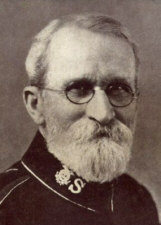 --Samuel Logan Brengle, leader of the early Salvation Army, in "The Soul-Winner's Secret"
Subscribe to:
Posts (Atom)